New Materialism: Old Materials
The eraser from a new-materialist perspective
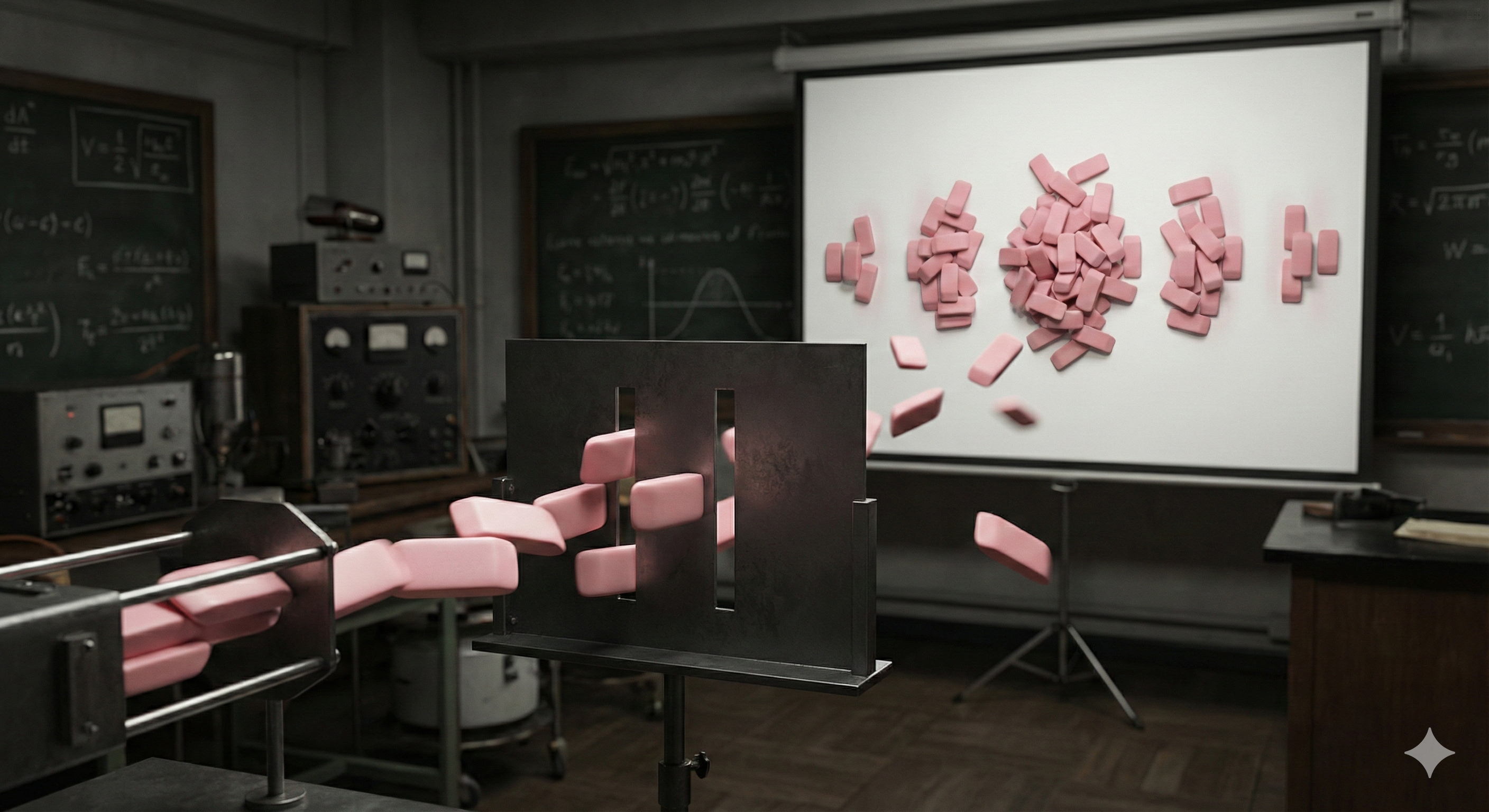
The double-slit experiment, but the photons are erasers. Generated by Gemini Nano Banana
An update of IP2
Toohey (2018) outlines Karen Barad’s quantum mechanical foundation for her approach to new materialism. I have always been enraptured by the unintuitive nature of the double-slit experiment: individual particles behave as waves, existing in superposition - attempt to measure them though, and that superposition collapses, and they simply behave as particles. The simple introduction of a detector entagles the particle to the detector’s state. For the new-materialist, Barad describes this entanglement at the macro-level as “intra-action” - entitities existing only in relation to one another.
The biggest challenge I faced in writing my original analysis of the eraser was the technology’s inextricable intra-action with the pencil. My essentialist (Monforte, 2018) analysis of the eraser evaluates it in a vacuum which resulted in - from a new materialist perspective (or agential realist ontological perspective, as Barad might put it (Hill, 2017)) - a sterilized and decontextualized description. I was self-aware of this ‘agential cut’ (Toohey, 2018) from the onset of my research for the assignment, as I quickly found that essentially every one of my key sources were not dedicated to the eraser, but as part of tangential asides in broader works on the primary subject of its entanglement: the pencil. From a purely technological development perspective, there is no eraser without the pencil. Petrosky (1990) notes Joseph Priestly’s 1770 reference to “gum elastic” as “the very convenient method of wiping out writing made with a black-lead pencil” as one of the first recorded examples of the rubber eraser. This description exposes the eraser’s intra-action with the pencil from its inception.
Of interest in the history of this intra-action is the 1862 patent litigation over the affixation of the eraser to the end of a pencil. The U.S. Supreme Court invalidated these patents on the basis of “no joint function performed by the pencil and the eraser; each performed the same function as before. The pencil was still a writing instrument and the eraser was still an eraser. Therefore the pencil and its eraser formed an unpatentable aggregation.” (as quoted by Petrosky, 1990). An overtly agentic cut on the part of the Supreme Court, who legally distinguished the two technologies despite the litigants’ decidedly Baradian assertion that this entanglement created something new, something neither distinctly ‘eraser’ nor distinctly ‘pencil’.
Though it is the most direct, the pencil is not the only entity caught within the eraser’s entanglement. Toohey (2018) contrasts the structural linguistic perspective of language as a symbolic system distinct from its practical use, with the new materialism view of language as a “material phenomenon”(p. 34) that exists through the entanglement of body, sound, visuals, affect, environment, and more. To the new materialist, the eraser is a piece of rubber. It is only through the tactile performance of rubbing, the smell of sloughing rubber, the removal of pencil marks, the distinct hue of Faber’s classic “Pink Pearl” eraser (Ward, 2014), the neo-liberal factory-model of education that demands perfect output, the prescriptivist linguistics that dictate grammar, the taste of the eraser as you chew on it, the eraser as a concept for removal so culturally ubiquitous it persists as a verb and symbol in a multitude of digital modalities, etc. It is through this amalgamation of semiotic, sensory, cultural, historical, and profoundly contextual connections that the eraser exists as a technology.
References
Hill, C. M. (2017). More-than-reflective practice: Becoming a diffractive practitioner. Teacher Learning and Professional Development, 2(1), 1–17.
Monforte, J. (2018). What is new in new materialism for a newcomer? Qualitative Research in Sport, Exercise and Health, 10(3), 378–390. https://doi.org/10.1080/2159676X.2018.1428678
Petroski, H. (1989). The pencil: A history of design and circumstance. Alfred A. Knopf.
Toohey, K. (2018). New Materialism and Language Learning. In Learning English at School: Identity, Socio-material Relations and Classroom Practice (pp. 25–44). Multilingual Matters. https://www.degruyterbrill.com/document/doi/10.21832/9781788920094-004/html
Ward, J. (2014). The perfection of the paper clip: Curious tales of invention, accidental genius, and stationery obsession. Touchstone.
AI Statement
Anthropic’s Claude was used periodically during the research of this assignment to help decipher some of the more complex passages of the key topic readings, and for lengthy questioning as I attempted to refresh my understanding of the double-slit experiment and its implications. Google’s Nano Banana Pro was used to generate the header image of this post.