IP6 - Holistic vs Prescriptive Technology
From the dictionary to the memory palace
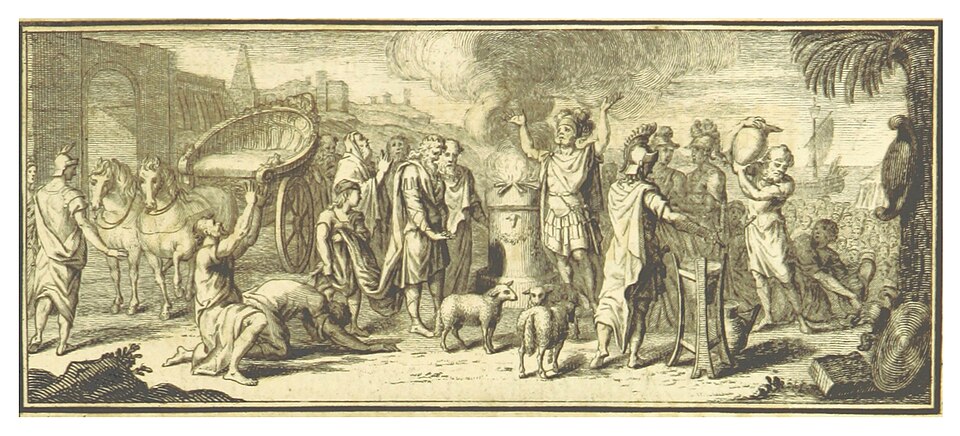
THE ILLIAD OF HOMER. Public domain, via Wikimedia Commons
Once when I was about 8 years old, I carelessly elbowed a hole in the drywall in a fit of frustration. I was mortified. My parent’s, never ones for strict discipline, opted to have me do the patch job myself and, for reasons unclear, to listen to the CBC Ideas broadcast every night that week. I vaguely remember falling asleep to Paul Kennedy’s voice for a few nights. This didn’t begin a romantic infatuation with the show, nor did it have any notable lasting impact, but its where I’m transported the moment I press play on Ursula Franklin (1989b) episode. The slow and deliberate pacing of Ursula’s utterances, her forceful vocal emphases, the introductory bustling noise of the audience, the occasional plosive, all assert themselves as key characteristics of the lecture as an ecological environment. As an educational technology, the lecture exhibits notions of prescription, namely through its transmission from expert speaker to ignorant listener, providing them with key instruction to which they should adhere. Eliminating all aspects of the lecture, save for the transmission of knowledge, and this prescriptive view may be correct. Listening to Franklin speak conveys a much more holistic sentiment though, one created through the intertwining of the many quirks, nuances, and subtleties of the recording.
Switching to Franklin’s (1989a) text of the lecture creates an abrupt shift. Suddenly the words I did not understand in the recording, the parts I tuned out of, are there for easy revision. I derive meaning from the text more efficiently, but its missing the constituent parts that make the lecture so special. Franklin’s discussion of prescriptive technology evokes, for me, David Foster Wallace’s (2005) essay “Authority and American Usage” on the “war” between American prescriptivist and descriptivist linguists. Both Wallace’s and Franklin’s prescriptivism seeks adherence through deconstruction and rules. Linguistic descriptivism aims to describe language as it is used, and holistic technology acknowledges a broader, tightly intertwined system. Both focus on recognizing the system, as opposed to breaking it down into smaller parts for more efficient usage.
Illich & Sanders (1988) pushes this conception further. The “memory palace”, a mnemonic technique for storing concepts, symbols, order, and ideas in a retrievable internal visualization, describes a holistic technology. This method of memorization is not one of rote accuracy, but one of impressive improvisation using an enormous memory palace ordering the constituent key phrases, standard words, and familiar tropes. Illich & Sanders’ contrast of oral vs textual technology positions the text as essentially prescriptive by nature. I will end on a quote that perfectly encapsulates, from my perspective, the opposing ends of prescriptive vs holistic technology.
“When epic tradition becomes a recorded one and custom is transmorgrified into written law, the poet’s sources are forzen in to the texts. He can follow the lines of a written text; the river that feeds its own source is remembered no more” (Illich & Sanders, 1998, p. 22).
References
Franklin, U. M. (1989a). The real world of technology. House of Anansi Press.
Franklin, U. M. (1989b, November 6). The real world of technology [Audio podcast episode]. In Ideas. CBC Radio. https://www.cbc.ca/radio/ideas/the-1989-cbc-massey-lectures-the-real-world-of-technology-1.2946845
Illich, I., & Sanders, B. (1988). ABC: The alphabetization of the popular mind. San Francisco : North Point Press. http://archive.org/details/abcalphabetizati00illi_0
Wallace, D. F. (2005). Authority and American usage. In Consider the lobster and other essays (pp. 66-127). Little, Brown and Company.